Tuesday, February 11, 2014

Delhi, India. Purana Qila complex. 01.08.2013

The grounds of the Purana Qila looking towards the Humayun Gate
About four hundred meters away from where the the Yamuna River is today, sitting on a small hilltop and walled even higher, sits what is referred to as the "Sixth City of Delhi". Delhi has been the capitol of several empires over the ages, and is numbered so. The Purana Qila is the oldest fort complex in Delhi while also holding the distinction of oldest structure.

The structure sits on the site of one off the oldest civilizations in modern day India, possibly dating back over 5000 years, on what is thought as Indraprastha, possible capitol of the Pandavas. Most of what we see today was built by the Afghan king Sher Shah Suri, but still was not finished upon his death in 1545.

lush green grounds are welcoming in the city

Inside the walls, there are only 2 structures left out of what is thought to have been hundreds of structures. Extensive grounds fill the void and is now a meeting place for families and lovers, sitting in the grass under the palms, and gazing out over the modern metropolis of Delhi.

West Gate entrance into Purana Qila
Entering through the West gate, we proceeded almost straight ahead a few meters to the largest structure on the grounds, the Qila Kuhna Masjid, as it rises in front of us, its multicolored sandstone facade glowing in the afternoon sun.

The back of the Qila Kuhna Masjid
The Qila Kuhna Masjid (Mosque), was built in 1541 by Sher Shah Suri and is a good example of Pre-Mughal design. The sandstone structure was at one time, covered in a layer of mostly white marble with complex inlays of various colored stones. It is still quite beautiful and the front courtyard overlooks Delhi, with young and old meeting here regularly.

The ground here is about treetop level of the modern city of Delhi

Late afternoon sun shines over the Qila Kuhna Masjid

Part of the outer wall defenses of the Purana Qila run right next to the Qila Kuhna Masjid

Inside detail of the single domed mosque, Qila Kuhna Masjid
The other structure that still stands on the grounds is the Sher Mandal. It was started by Farid (Sher Shah) and was finished by Humayun. It is a two storied tower, which was intended to be higher, but finished nonetheless, and used as a library and observatory by Humayun. It is also one of oldest observatories built in Delhi.

The Sher Mandal
In January of 1556, Humayun, tripped and fell headlong down the flight of stone stairs on his way to prayer. He passed two days later. Entrance into the structure is now forbidden.


The grounds of the complex was also used as refugee camps upon the Partition of India in 1947. Nearly 200,000 refugees were encamped here, as well as Humayun's tomb, while waiting for the newly formed Indian government to work out the train situation for getting those who wanted to go to newly formed Pakistan, including thousands of government employees willing to relocate.

There is so much to see in Delhi, I guess it should start where it all started anyway. The Purana Qila is steeped in history older than most of can imagine. I'm just glad India is not like America, or there would be a mall and a parking lot where the Purana Qila still sits today.

Tuesday, February 4, 2014

A look back. Pondicherry, Tamil Nadu, India. 27.03.2011

Sunrise over the Bay of Bengal, Pondicherry, Tamil Nadu, India
I would consider myself a traveler, rather than a tourist. I will never take a narrated tour of anyplace, group tour or don headphones. I go where I like to go. I like to see some of the touristy spots, there is no way around that. But I do love to head off the beaten path, small towns, roads less traveled. I do that here in my home state of Virginia when traveling somewhere, and I most certainly do that in a country such as India.

After a couple of weeks on the road in South India, we found our next stop was Pondicherry, or Puducherry as it is now called locally. "Pondy" is also used by locals and ex pats alike. We had, or, truth be told, my wife, had sketched out this itinerary the month prior, and so far we had almost stuck to it. For a while now, I had considered Pondicherry as one of my least favorite places we had visited. Or so I thought.

We stayed at the Sri Aurobindo Ashram, at the southern end of the Promenade, the long straight beach-side boardwalk, where everybody seemed to gather. The Ashrams accommodations are sparse to say the least, but the grounds were nice and it is fairly close to most everything.

Seaside gardens of the Sri Aurobindo Ashram

Pondicherry seemed different to me than any of the other places that we had stayed so far in India. I was not sure why, until reading up on the history of the city. Pondicherry has been, in one form or another, a port of trade and controlled by the Romans, French, Dutch and English, as well as many Indian rulers over the ages. With this, came influences in the form of architecture and urban planning. It definitely has a more European feel than that of an India one. The tree lined streets even made me feel like I was in my own capitol city, Richmond, in the Fan district.

The main areas are known as Heritage Town, and White Town are laid out in a grid and ringed by a main road and flanked by the Bay of Bengal. The Sri Aurobindo Ashram is comprised of many buildings and ventures, spread all over Pondicherry. We made our way to the Sri Aurobindo Ashram site where they make the famous Marbleized paper and Sarees to get some gifts for my mother in law. These were highly regarded by the women in my wife's family for many years.

Tight, tree-lined streets line up in a grid pattern

The marbling of paper is an ancient art first practiced in Japan in the ninth century. Completely realized by hand, it consists in producing certain patterns and effects by means of colors on water. A piece of paper or silk is laid on the water, so that the flowing patterns get imprinted on it. The marbling unit in the Ashram started as a hobby in 1965. Some sadhaks experimented with this art form and offered marbled handmade paper to the Mother. Later they extended the marbling process to silk. As it was widely appreciated, the Mother permitted the sale of these products. From 1970 onwards the unit took up work on a big scale with the production of sarees, scarves, stoles, ties, kerchiefs, dress material and dupattas on pure silk and pure silk chiffon, for sale locally and abroad. Today marbling has developed into a fine art form to which the Marbling Group has undoubtedly the credit of having added certain refinements, apart from having been among the first to adopt the process successfully to silk fabrics.- Ashram website

Marbleized silk saree

Marbleized paper. Each one is unique. The boxes are indicative of what the pattern is inside.
In front of the Sri Manakula Vinayagar Temple, for a mere rupee coin, you can be blessed by an elephant. The elephant is considered auspicious by the Hindus, and to be blessed by one even more so. For me it was something that I had seen in a travel video and hoped that I too could partake in this ritual. I was not disappointed, as this very act made me swell with happiness.


Our morning sunrise ritual was considerably altered when we encountered massive amounts of people had the same idea and we did not have our usually quiet morning stroll along the Promenade. It seems that Pondicherry is a very popular vacation spot for Indians and they had the same idea. But the sun does not know this and treated us just as well.

lone pot left on a sidewalk. Pondicherry, India
The one thing I have just realized, while writing this, is that maybe I really did like Pondicherry. Maybe I liked it a lot. There was a lot to do there and looking at the photographs, I might want to go back one day. One thing I know is that I have learned more about photography, and that these places I have documented for myself and for my four boys to learn and enjoy upon my passing, lend themselves to fantastic photography. I have shot these with a Canon point and shoot. Boy what I could have done with DSLR with a couple of lenses.

woman at the temple making and selling mogra

Rangoli art outside a doorstep

very artistic graffiti adorns a blank wall. Pondicherry, India

Beautiful Passionflowers everywhere
the moon getting caught out during the rising of the sun

garden sculpture at the Ashram


Tuesday, January 14, 2014

Kerala backwaters are calling me back 20.03.2011


Sunset over Lake Vembanadu
One of my favorite stops so far in India was the backwaters of Kerala. Serene settings with fabulous sunrises and sunsets, this, to me, was a place to go to really unwind and relax. We arrived from Munnar close to sunset, and I was able to really get a feel of relaxation looking over the waters of the huge lake in front of me.

We stayed in a small resort, very nicely appointed but not to pretentious called Kumarakom Lakeside Resort. A family run operation, small but efficient, and I felt like a king on vacation. Our separate villa was lakeside and the view was tremendous. We had a few guests in our room, Geckos, and I was summoned by my wife to rid the place of them or sleep alone. While I'm not used to these wonderful creatures, I do know their importance and understand that they take care of the absolute unwanted party crashers, mosquitoes. I like the symbiotic relationship.

My view from the front porch of our villa.

As I have talked about in past posts, we really enjoyed getting up early and watching everything come alive. We woke early and walked down the main road, which is a dead end, so there was not much activity, found a chai wall and had our morning cup on the roadside listening to the sounds of the birds. Such different, incredible sounds, completely different from North American bird sounds.

Early morning sunrise over the backwaters

Life is slow here, allowing one to really take in the beauty
One of the things I love about India is that while I am just a visitor, for a very short time, everyday life goes on all round me while I am there and it is fascinating to me, and to the people I see or meet, it is business as usual. I wonder what they would think of my life? Not much, I can tell you!

This man would climb the trees on the grounds and drop down the coconuts, so that they wouldn't fall on the heads of guests. His payment for such services? Those same coconuts.

Local boys swimming and laughing amongst the Hyacinth in Lake Vembanadu

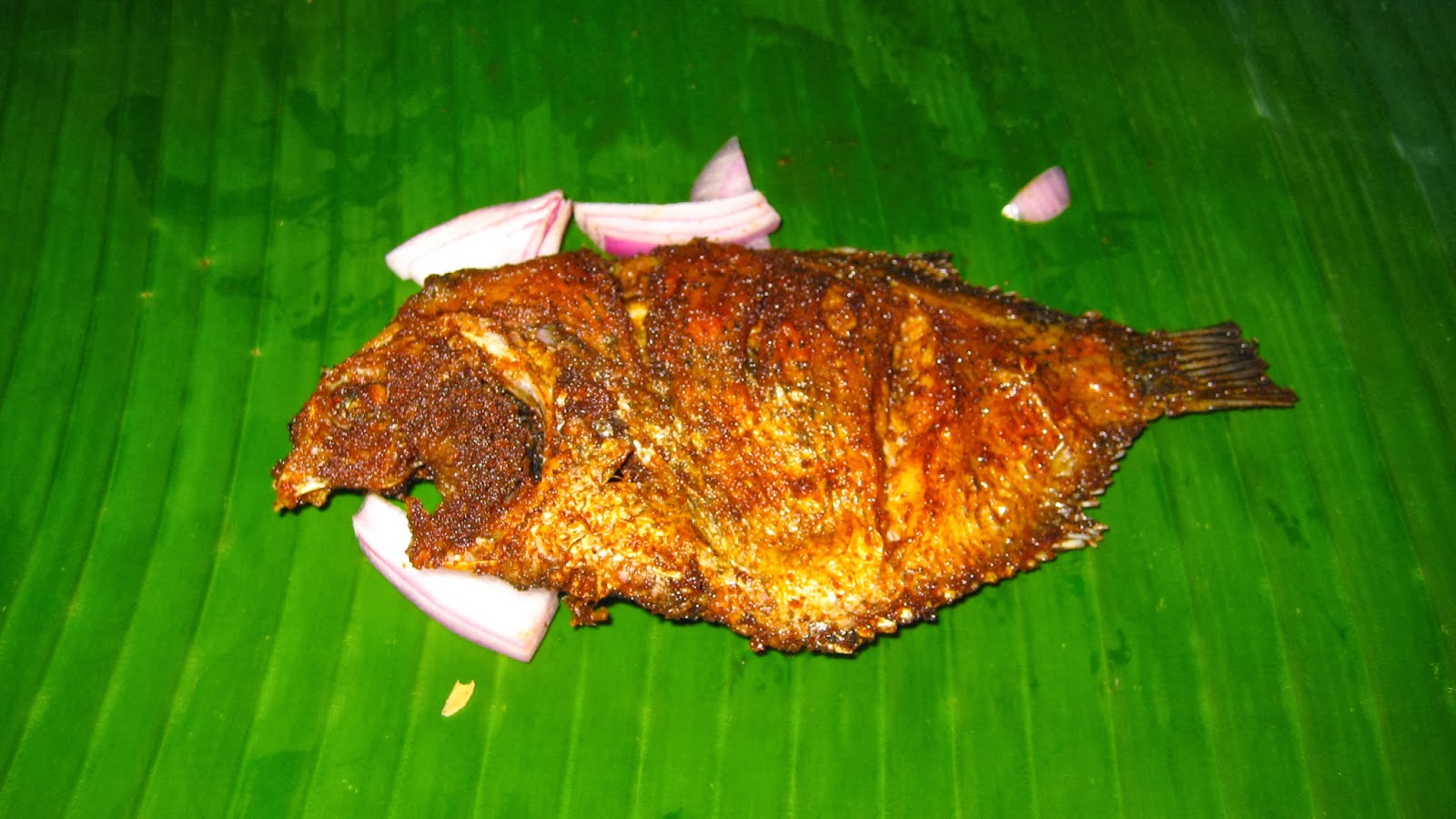
We took a boat tour through the backwaters, passing fishing boats and clam diggers, gathering their trade the same way it has been done for thousands of years. We were treated to slow puttering journey, past these men, past the palms, and wildlife, to a small building in the middle of a vast area of water. Built on dry land, local would walk along narrow spits of land to get here by foot, or moor their boats and head on in. We were treated to a tasty fried fish with fresh onion and lime, served on a banana leaf.
The setting, along with the trip and the food itself, made for one of the best meals I've had in India. It's not just the food, but the experience.

Our boat moored in the Hyacinth

The character of a real wood boat lended to the mystique and feeling of visiting in another time

One of the local Keralites enjoying a smoke

The best fish I've ever had? Possibly. The setting didn't hurt either!
Our little restaurant oasis
I think next time we might do the house boat, sleeping and eating directly on the backwaters. But I really enjoyed our stay where we did.

One of the many houseboats plying the waters

detail of the boat we hired for the day

Open waters and beautiful scenery

Paradise? It could be!

Clammers jump out of their boats and dive down to bring up their haul
So much different than the hustle and bustle of big cities like Delhi, Kumarakom, Kottayam, Kerala India is a place one can go to truly relax and unwind. I plan on doing just that at least one more time before I die.

Monday, November 25, 2013

A look back. Kanyakumari, Tamil Nadu, India. 24.03.2011

Kanyakumari

We left Kovalam on the 24th of March, 2011 and headed south, to the southern most tip of the Subcontinent of India. Our destination was Kanyakumari, where 3 oceans meet, the Arabian Sea, Bay of Bengal and the Indian Ocean. It is a very sacred place, where devotes of Kanya Devi and religious pilgrims of all kinds flock by the tens of thousands to visit the Vivekananda Memorial and the Kumari Amman Temple.

It was a different feeling, coming to the end of something as significant as a Subcontinent. I've never been to Key West, or Cape Horn or the Horn of Africa, but I would imagine the feeling would be the same. And to stand where 3 oceans converge is also something to boast about.

Ptolemy wrote of the relationship between Kanyakumari and Alexandria, and this relationship would have been forged many years prior to Ptolemy and for many years after. Trading in pearls and being an important route point for sailors at the time, meant that Kanyakumari would always be a hub of activity.

Today, Kanyakumari, aside from being a pilgrimage spot, is also an active tourist destination not only for India, but for the entire world. There are plenty of hotels and restaurants between the main roads and the tip of the land, as well as a plethora of souvenir shops that really crank up in the evening.

Looking at the entrance to the Kumari Amman Temple, with the Vivekananda monument in the far background. In between, is the Thiruvalluvar Statue. It is a 133 feet (40.6 m) tall stone sculpture of the Tamil poet and saint Tiruvalluvar, author of the Thirukkural.

We woke at 3:30am in order to wind our way to the Kumari Amman Temple, which is dedicated to the virgin goddess Kanya Devi. We were not a lone of course, but the crowds were definitely smaller at this hour, at which only the truly devoted dare to venture.

After experiencing a wonderful puja, we left the temple to go back to our hotel. The streets were very empty, just my wife and myself and a handful of worshipers leaving the same temple. Walking ahead of us was an elderly gentleman, wrapped only in his dhoti, walking with a staff and singing. It was mesmerizing. His voice, weakened due to age and the fact that he was slumped over, still wafted through the empty streets and filled my wife and me with joy. it was haunting, but in a good way. It is times like these that make it wonderful to be a traveler.

very early sunrise

about an hour after sunrise


A popular event is the sunrise viewing from the rooftops. We had been getting up quite early anyway along the journey, to view the magnificent sunrises, so doing it here was not anything out of the ordinary. We got up early and headed for the roof were about two dozen sleepy-eyed hotel patrons had the same idea! As I looked out over the city I saw many of the rooftops in a similar state, loaded full of people hoping to capture a glimpse of what would hope to be a spectacular sight. It did not disappoint.


Suchindram Thanumalayan Temple


We also took a side trip a few kilometers away to the Suchindram Thanumalayan Temple. This was one of my favorite temples on the whole trip. I love architecture and I love history, and this temple had both. It has a huge Hanuman statue carved out a single block of granite. It was buried in 1740 to prevent it from being damaged in an attack from the Tipu Sultan, better known as the Tiger of Mysore. It was forgotten until it was rediscovered in 1930.

The temple Brahmins, aids and priests were very nice to me, giving me the full "treatment" of a VIP. They were patient and supportive and showed me how to do things properly. There are many rituals that are performed in a specific order and you need someone with you that knows them or get someone to help you. I wanted to be immersed in it, to experience everything like I had done it all my life. We were escorted into the inner sanctum, which was a treat. These temples are unlike religious buildings in the west. They are made from large solid blocks of granite, moved into place in a way that time has forgotten, and are carved so precisely that there is no need of mortar. It smells of centuries of incense, oils and flowers and is very unique.

Swami Vivekananda Memorial


Carving detail

For some, this is a lifelong journey

Looking from the steps of the memorial back towards land

Looking dead south from the tip of India

 A few hundred yards off the tip of land is the Vivekananda Rock Memorial. Only accessible by ferry, this large rock outcrop is said to have been the place Swami Vivekananda swam out to and meditated and actually attained enlightenment. There are several attractions on the rock, one of which is a compass rose set into the stone that points due south. The temple building is quite nice and has elaborate carvings. It was built in 1970.

We also visited the Vivekananda Kendra or the ashram of Swami Vivekananda. There is a nice museum that shows a great timeline of his influential work. There is also a Memorial to Mahatma Gandhi, but I was very disappointed with that and thought it was lacking in anything substantial and does not do the great Gandhiji justice. It it situated on the spot where his ashes rested before being scattered into the sea a few yards away.